CASE FILE No. 002 · ON RECORD
751 · WBFF FITNESS-COMPETITION PHOTOGRAPHY
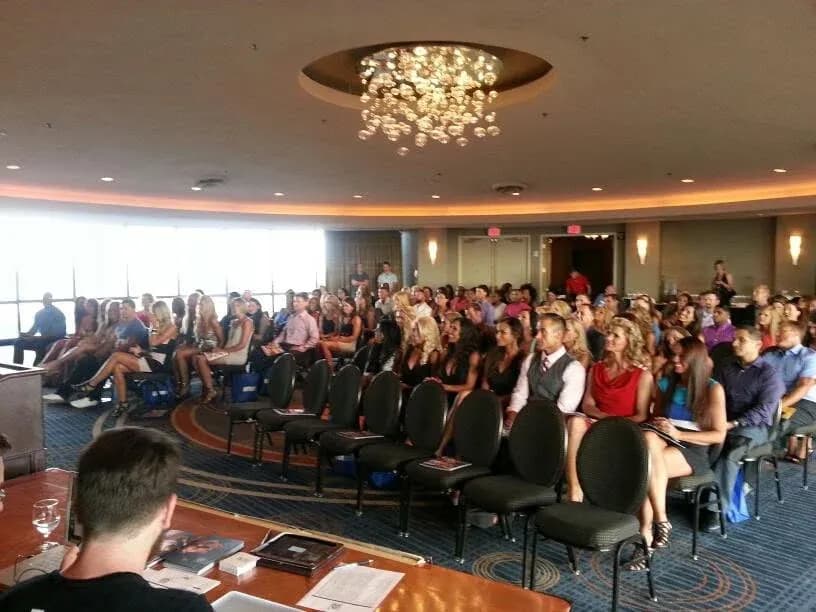
The room sold itself before the show ended.
THE ENTRY MOVE
He didn’t out-compete a crowded field. He made it irrelevant.
THE FILE
David didn’t walk into a crowded market and outcompete everyone. He didn’t build a brand or buy ads. He identified a small, underserved niche that matched an edge he already had — a lifelong martial artist and competitive athlete who understood bodies, movement, and how a competitor reads on a stage — and he got in by doing a free shoot for one trainer-competitor as a beachhead.
That’s a repeatable move. It’s not hustle. It’s market selection.
The photography category at the time offered the same product everywhere: beautiful stage portraits, delivered in four to six weeks. The industry standard, unquestioned. David asked the question underneath it: what is the photo actually for?
Pre-Wabbit — This predates the company. It’s the first time David ran the method Wabbit would later build on — proof it worked before there was a brand behind it
Market Discovery · System Design · Live Operations · On-Site Sales
A category that had never been asked the right question.
The fitness-competition circuit is a specific world: athletes who train for months, compete in a morning and an evening show on the same day, and are judged almost entirely on how they read from the front — a line of sight they cannot see themselves.
The photo wasn’t a keepsake. Placing top-ten in a WBFF show can open real doors — sponsorships, magazine coverage. The most useful thing a photo could do wasn’t commemorate the day. It was to show the competitor exactly what the judges saw, in time to adjust before stepping back on stage that evening. Nobody had ever built for that job. The four-to-six-week delivery window wasn’t a failing of any one photographer — it was the shape of a category that had never been asked the right question.
FROM THE FILE
The real job: show me what the judges saw.
What a competitor cannot see themselves — the angle they’re judged on — while there’s still time to change it before the evening show.
PLATE 01

THE MECHANISM
The insight was clear. The execution was hard — and it needed two people.
Getting images from camera to competitor within an hour, on-site, at a live event, required a system — and a system requires someone to run it.
David designed the pipeline: real-time tethered capture into Lightroom, culled and organized per competitor, exported to individual galleries, delivered on-site before the evening show. That design is what made the offer possible. But the live half — sorting images to the right competitor in real time, while the event was happening — required a second person running it without stopping. Loni did that. The thirty-to-sixty-minute turnaround was not possible without her.
THE PIPELINE
- Real-time tethered capture into Lightroom.
- Culled and organized per competitor, exported to individual galleries.
- Delivered on-site before the evening show — a sub-60-minute turnaround, target morning show to images in hand.
The insight belonged to David. The execution — sorting images to the right competitor in real time — belonged to Loni. Neither half worked alone.
YEAR ONE
No exclusivity. No reputation. No captive market. The room still sold itself.
Year one: no exclusivity contract, no established reputation, no captive market. David and Loni showed up and did the work. Competitors who bought in the morning had their galleries before the evening show. Competitors who hadn’t bought saw that. Some came to the table before the show even ended.
That’s the part of the story that matters most, and it’s the part that gets buried when the headline becomes “100% over four years.” The flywheel started on speed and quality alone — before there was any structural advantage. The exclusivity contract came later, as a result of that demonstrated dominance. The organizers gave David the exclusive because he’d already made himself the obvious choice.
No exclusivity, no reputation, no captive market — the flywheel started on speed and quality alone, before there was any structural advantage.
THE HONEST CAVEAT
The later years had a monopoly assist. Year one didn’t.
An honest account of this: the exclusivity agreement (year two onward) closed the category. After that, the 100% close rate reflects a monopoly arrangement as much as method. Competitors at a WBFF event in the Midwest didn’t have another option — they could buy from David or go without.
That’s worth naming because the interesting proof is year one, not years two through four. The year-one story — where David earned the room before the exclusivity existed — is the honest validation of the method. The later years are evidence that once a category is dominated, it stays dominated. That’s real, and it compounded well. But it’s a different kind of proof.
FROM THE FILE
The turnaround wasn’t a feature. It was the entire offer.
The between-shows workflow: an on-site production line built so a competitor had the answer in hand before the evening show started.


See what the judges saw — immediately.
The photograph every competitor actually wanted was the one angle they could never see: themselves, from the judges’ table.
The offer was that photograph, delivered before the adrenaline faded. Nearly every competitor offered one took it.
THE OUTCOME
A room that sold itself, on product alone, before the show ended.
Over roughly four years, 751 competitors bought the gallery package. But the real number is the year-one proof: a room that sold itself, on product alone, before the show ended. That’s the part of this that translates — and it happened before any exclusivity existed.
Every offer sold: 751 offers, 751 gallery packages, by David’s own count. It counts sales, not revenue.
These figures are from recollection — there are no digital records from this period — so we treat them as directional, not audited. We won’t harden a number we can’t verify. The “100% over four years” line combines two different conditions: a year-one, market-earned flywheel and a multi-year exclusivity arrangement that removed the competition entirely. Both are true. They’re not the same thing, and we won’t pretend they are.
Figures are from recollection — there are no digital records from this period. Directional, not audited.
David ran both halves himself — the method and the business — which makes this the cleanest, most attributed proof of the approach in the record: no equity complications, no relay through a client’s decisions. The Wabbit method (pick a niche matched to an unfair edge, do cheap beachhead work to earn a reference, build only for the validated job) runs through this case in its first instance.
MORE FROM THE FIELD
See the rest of the work.

CASE FILE
$250 → $15M → collapse
Forex education platform
The Swag Academy
Read the case file →
CASE FILE
Made being wrong cheap
Validation · kids' EdTech
LiteStreet
Read the case file →
WHERE THIS STARTS
Book the Architecture Sprint
This case ran on one move: pick a niche matched to an unfair edge, then build only for the job the market actually has. The Sprint is how we find that move for you — before anyone spends a dollar building the wrong thing.