
CASE FILE
THE SWAG ACADEMY · FOREX EDUCATION
A $250 test, a $15M platform, and the collapse that built Tome.
THE ENGAGEMENT
WHO HE WAS
Authenticity in a market built on hiding the truth.
Chris "Swaggy C" Williams arrived with reality-TV fame and 370,000+ followers — and $106,000 in debt. Rather than hiding that reality, he chose to document his genuine learning journey, sharing both successes and failures as he developed his trading skills. In a category built on hiding losses, that transparency became his greatest competitive advantage.
That was the raw material. The question was never whether he was real — it was whether anyone would pay for it, and whether the thing we built to serve them would hold.
THE HONEST PREFACE
Distrust the number. Then read what it cost.
"$250 became $15M" is exactly the kind of number every forex guru on the internet fabricates — it is the worst possible market to make that claim in. So we are not going to ask you to take it on faith, and we are not going to stop at the win.
This is the story of how a $250 MVP correctly validated real demand, how the platform that followed scaled to roughly 20,000 students and $15M, and what the eventual collapse of that platform under real load taught us — lessons that now sit at the foundation of everything Wabbit builds.
Everyone competed on the size of the promise.
The forex education market has a credibility problem. It is saturated with self-proclaimed gurus making unrealistic promises, leaving potential students skeptical and burned by previous experiences. Buyers arrive having learned to smell the pitch coming.
The global e-learning market hit $250B during 2020-2021, and financial education specifically saw unprecedented demand as retail trading surged 300% during the pandemic. Success required not just good education, but proof that the approach worked before asking for significant investment.
THE CHALLENGE
The challenge was never technical.
Any agency can build an e-learning platform. The real question: how do you enter a saturated, skeptical market with an unproven business model while minimizing risk and maximizing authentic value? The forex space is full of over-promising marketers who damage trust for everyone, so success required proof that the approach worked before asking for significant investment.
STRATEGIC CONSTRAINTS
- No validated demand for Chris's specific teaching approach.
- Limited budget requiring careful resource allocation.
- Need to preserve the authentic relationship with his existing audience.
- Competitive pressure from established players with bigger marketing budgets.
OUR APPROACH
Treat every business decision as a hypothesis requiring proof.
Most businesses fail not because of poor execution, but because they build something nobody wants. By proving demand first with minimal investment, then scaling only validated successes, we could eliminate the single biggest startup risk before spending real money.
OUR GUIDING FRAMEWORK
- Validation before investment — prove every assumption with data before committing resources.
- Systematic testing — every initiative is an experiment with a clear success metric.
- Risk mitigation — use minimal viable tests to gather maximum learning.
- Iterative scaling — build on proven successes rather than untested theories.

PHASE 1 · THE MVP
The $250 test. Before one line of platform was written.
PHASE 1 · THE MVP
The $250 test. Before one line of platform was written.
A simple landing page with pre-order capability and real analytics — not a prototype, not a wireframe. A real offer with real money on the table. It generated 66 pre-orders. That was the proof that everything that followed was worth building.

PHASE 1 · THE RESEARCH
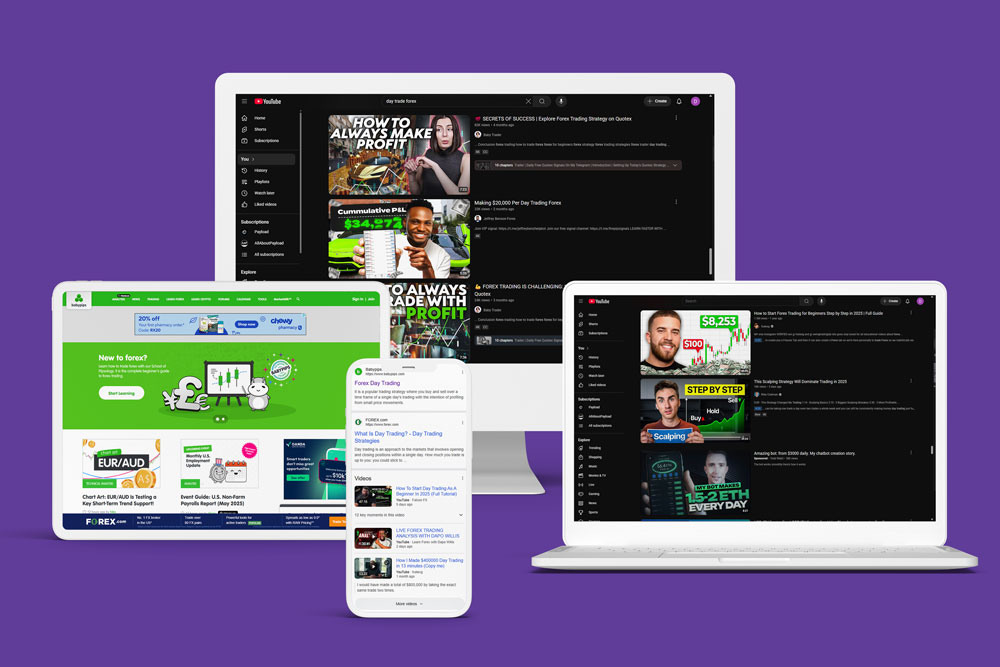
The market was crowded. The opportunity was in the gap.
Psychographic research surfaced the exact profile: 18-30, $10K–50K income, chasing financial independence, already burned, deeply skeptical of every promise. Competitive analysis showed most players competed on marketing volume, not substance. That gap was the positioning.


PHASE 2 · THE BUILD DECISION
Enterprise functionality. Not enterprise risk.
With 66 pre-orders proving real demand, the next decision was the make-or-break one: build a custom platform for $50K–100K+ before the model was proven, or find a smarter path? We chose LearnDash — it delivered roughly 80% of core platform functionality at a fraction of the cost, saving 6+ months of development time and reducing technical risk to near zero at the scale we could then foresee.
What we could not yet foresee was where that ceiling would be. That is the honest part of this story.
PHASE 2 · THE PLATFORM
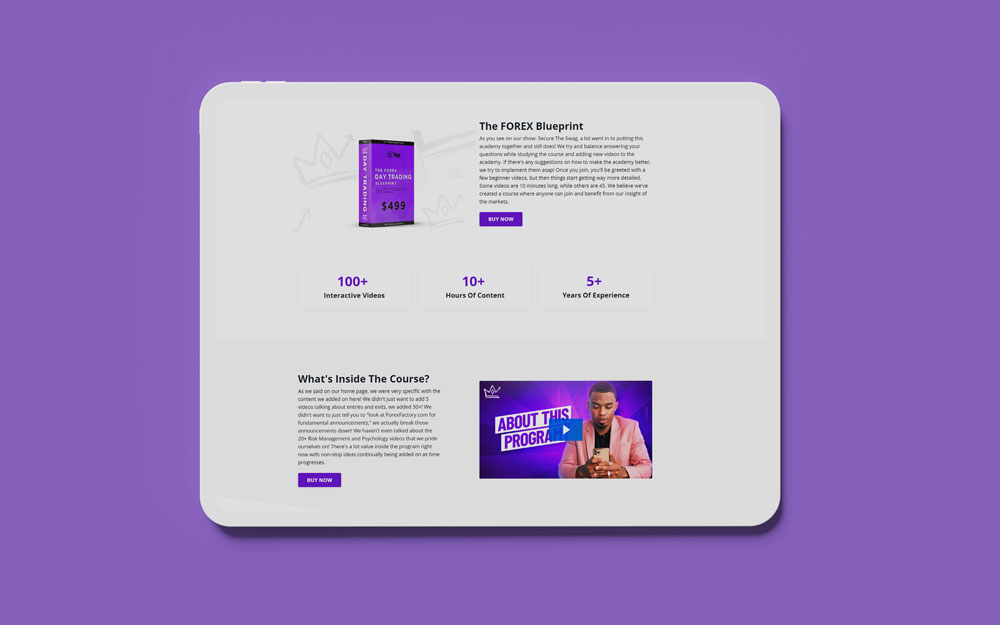
Built on what the $250 test proved.
The storefront shipped only the offer the demand test validated — nothing speculative, nothing unproven. Every feature earned its place before it was built.

PHASE 2 · THE LEARNING SYSTEM
Structured learning, built to hold.
The glossary and curriculum framework were built on learning-science principles — progressive content unlocking, structured progression, terminology that made the subject accessible to a skeptical, beginner audience. Enterprise-grade structure on a validated budget.

PHASE 2 · THE ARCHITECTURE
The right call for the scale we could see.
WordPress, Stripe, LearnDash, and WishList Member — a stack that delivered proven functionality without betting the budget on custom infrastructure. The right architecture for the problem in front of us. The ceiling it had would only become visible later, under load neither the platform nor we had encountered before.

PHASE 3 · GROWTH & OPTIMIZATION
Every growth initiative was an experiment.
Landing pages, email sequences, onboarding, and pricing were systematically tested — every growth move an experiment with a clear metric, every dollar allocated on proven performance rather than hopeful assumptions. Staff training and process documentation kept quality stable as the team grew.
WHAT THAT TOOK
- Conversion testing — landing pages, email sequences, and onboarding flows optimized at every stage.
- Pricing strategy — multiple price points and payment structures tested against real buyer behaviour.
- Content testing — multiple formats across YouTube and Instagram, budget scaled toward what converted.
- Staff training — process documentation and onboarding built to hold quality as the team scaled.
PHASE 3 · THE CONTENT ENGINE
Content that earned trust in a market full of noise.
The YouTube strategy was part of the positioning: Chris's authentic documenting of a real learning journey, tested against the audience before budget was committed. The channel header and brand identity were built to stand apart from the forex-guru aesthetic deliberately.

PHASE 3 · THE OPTIMIZATION WORK
Systematic testing, not guesswork.
Every landing page, every onboarding step, every pricing tier was a controlled experiment. The conversion optimization work was the ongoing process — the artefact of a method applied consistently, not a single tactic.
PHASE 3 · THE GROWTH ANALYSIS
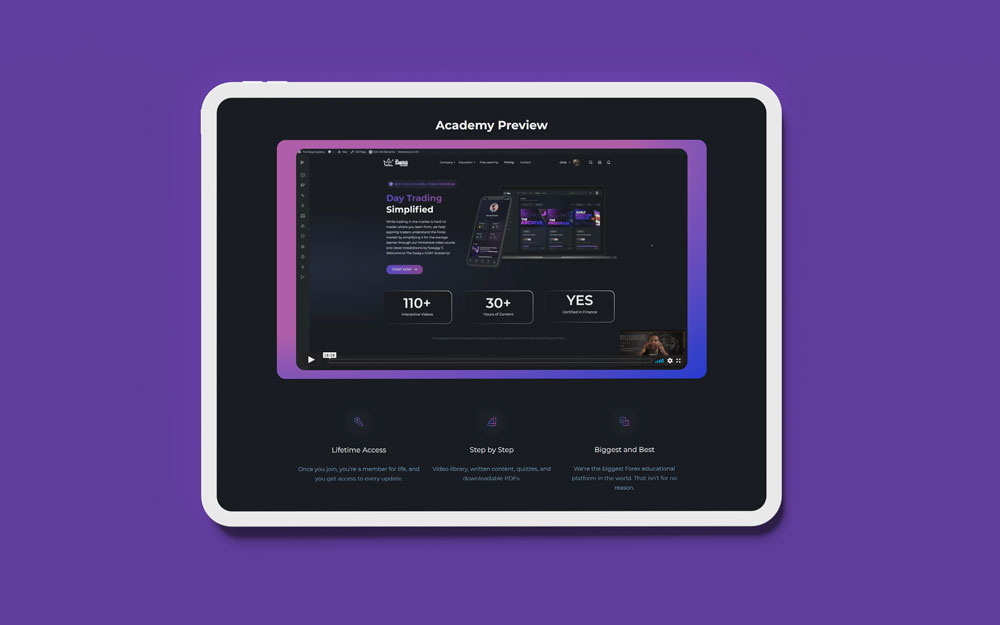
Growth, measured — not guessed.
The monthly growth analysis was the instrument: a running read on which experiments were working, so spend followed proven performance instead of hope. It is the analytical backbone of the whole growth phase.

PHASE 3 · THE PRICING MODEL
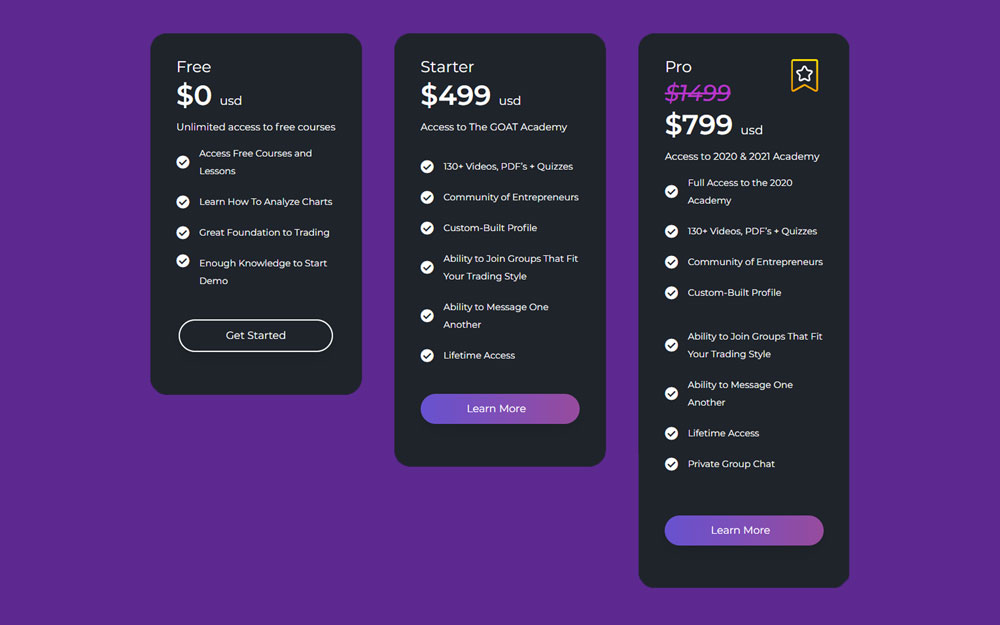
Price points, tested against real behaviour.
The pricing strategy was built and tested the same way as everything else — multiple price points and payment structures run against real buyer behaviour, so the model rested on evidence rather than assumption.
PHASE 4 · CONTENT & EXPERIENCE
Individual learning turned into collaborative success.
Rather than following traditional course structures, we designed a community-driven learning environment. Social-feed activity, customizable member profiles, integrated messaging, and user-generated content — members could upload trading screenshots, analysis, and progress updates within profiles and group forums, turning peer activity into learning catalyst.
A companion mobile app delivered full feature parity for on-the-go access, built on the same LearnDash backend.
PHASE 4 · THE MOBILE APP
The full platform, in the pocket.
The companion mobile app carried full feature parity — the same course content, community feeds, and learning progression as the web platform, optimized for mobile learning behaviours and built on the same LearnDash backend.
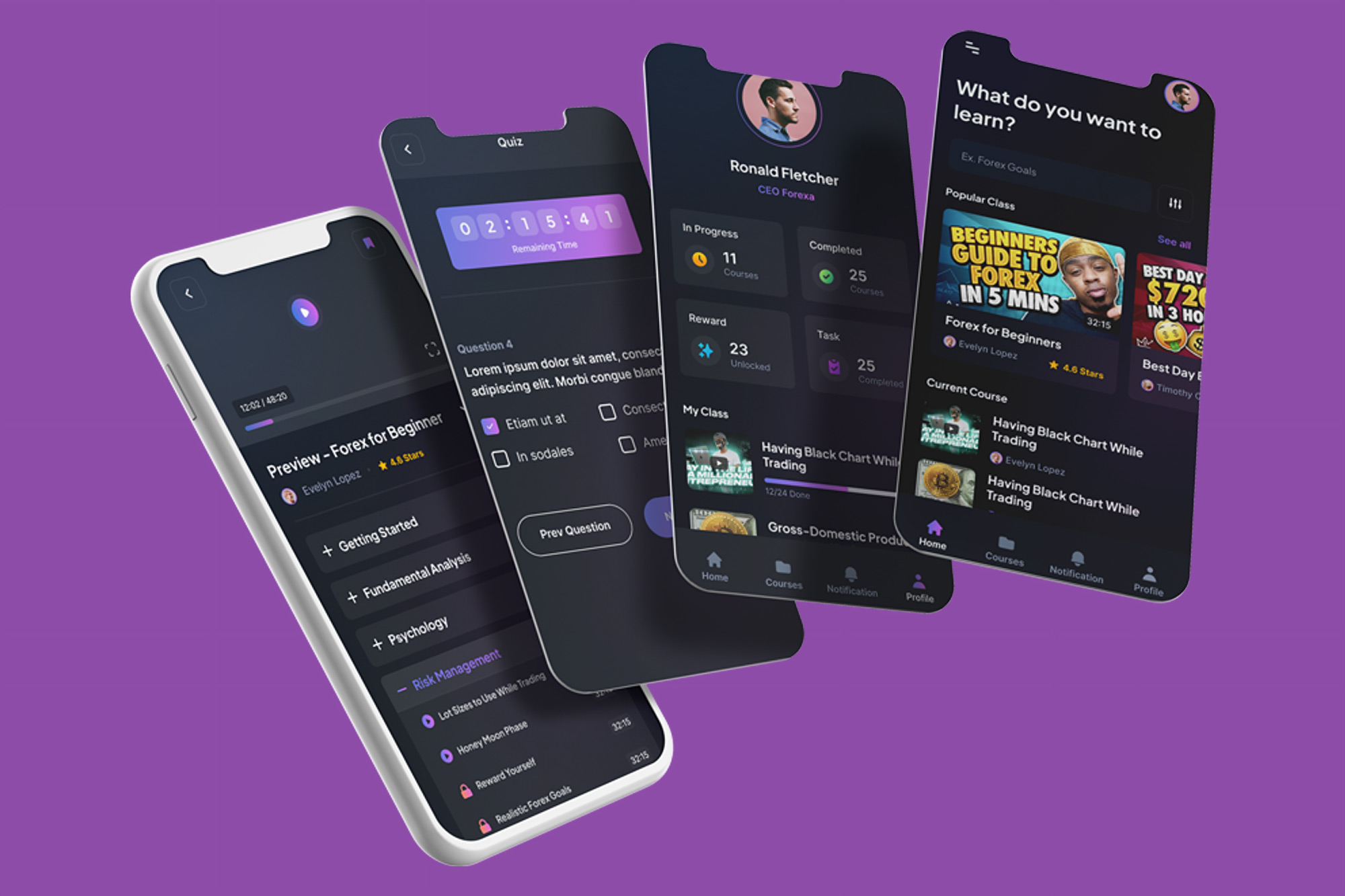


Social-feed community platform — BuddyBoss-backed, built for ~20,000 concurrent learners.
PHASE 4 · COMMUNITY PLATFORM · BUDDYBOSS
PHASE 4 · THE PLATFORM IN USE
The platform in the room where the learning happened.
Group lessons, live sessions, and community discussion — the platform was built to support the full learning experience, not just content delivery. The Swag Academy ran live group instruction at scale.

AND THEN IT FAILED
The architecture had a ceiling, and the business hit it.
The validation was genuinely predictive — the 66 pre-orders were not a fluke, and the platform scaled to roughly 20,000 students and $15M. And then the platform failed.
At roughly a quarter-million visitors with 15,000–20,000 concurrent users, the interaction between BuddyBoss, Elementor, and LearnDash produced a database over-querying problem the stack could not handle at that load. The architecture that had been the right call at launch — proven, fast, cost-effective — had a ceiling, and the business hit it. That failure is the honest reason Wabbit went on to build Tome: scalability is now the requirement everything is built around, not an afterthought.
That failure is the honest reason Wabbit went on to build Tome.

THE OUTCOME
The arc from experiment to platform to collapse — every figure verified.
- $250
Total demand-validation budget — a landing page with pre-order capability and analytics
- 66
Pre-orders the MVP generated — real demand proven before a dollar of platform was spent
- ~20,000
Students enrolled by peak
- $15M
Revenue generated 2020-2022, before the architecture hit its ceiling
WHAT THIS IS ACTUALLY PROOF OF
The validation method was correct. The architecture was not enough.
The $250 experiment to $15M platform to architectural collapse is the honest story — and it is more useful than a success-only account, because it names the actual problem Wabbit now builds to solve. The validation method was right. The platform architecture had a hard ceiling that the stack could not clear.
The Swag Academy taught us that lesson at a cost we could not ignore. That is why scalability is the requirement everything we build is now organized around — not a future concern, not something to optimize later.
Scalability is now the requirement everything we build is organized around.
MORE FROM THE FIELD
See the rest of the work.
CASE FILE
751 competitors
The first proof of the method
751 / WBFF
Read the case file →CASE FILE
Made being wrong cheap
Validation · kids' EdTech
LiteStreet
Read the case file →
WHERE THIS STARTS
Book the Architecture Sprint
The Swag Academy started with one move: validate the real job before building. And it ended by teaching us what to build around. The Sprint is how we figure out the right system for you — and make sure it has room to grow before anyone spends a dollar building it.